Article-At-A-Glance
- Effective keyword research is the foundation of SEO success, directly impacting visibility and traffic potential
- CognitiveSEO’s Keyword Explorer provides a streamlined way to discover valuable keyword opportunities beyond just search volume
- Understanding search intent is crucial for matching content to what users are actually looking for
- Long-tail keywords typically have lower competition and higher conversion potential for beginners
- The 5-step keyword research process using CognitiveSEO can help beginners find strategic opportunities their competitors might miss
Keyword research isn’t just a box to check—it’s the foundation of every successful SEO strategy. Without the right keywords, even the most beautifully designed website remains invisible in search results, essentially non-existent to potential visitors. If you’re just starting out, the process might seem overwhelming, but with CognitiveSEO’s intuitive toolkit, you can cut through the complexity and build a keyword strategy that actually drives results.
Finding the perfect keywords is like discovering hidden treasure maps that lead users directly to your content. The right approach combines art and science, balancing search volume with competition level and user intent. CognitiveSEO simplifies this process by focusing on what truly matters, helping you build a strategic foundation that grows your visibility where it counts most.
Why Your Website Is Invisible Without Proper Keyword Research
“The best place to hide a dead body is page 2 of Google search results.”
— Unknown SEO Humorist
Without proper keyword research, your content exists in a vacuum. You might be creating brilliant resources that nobody will ever find because you’re targeting terms no one is searching for, or worse, terms so competitive that your chances of ranking are virtually zero. Search engines can only connect users to your content when there’s alignment between what people search for and what your website offers.
Many beginners make the critical mistake of guessing what their audience is searching for instead of using data-driven tools like CognitiveSEO to uncover actual search behavior. Your instincts about what terms people use might be wildly different from reality. Even slight variations in terminology (like “how to start blogging” versus “beginning a blog”) can represent entirely different audience segments with different needs and conversion potential.
The impact of proper keyword research extends far beyond just traffic numbers. It directly influences bounce rates, time on site, conversion rates, and ultimately revenue. By targeting the right keywords, you’re essentially pre-qualifying visitors, ensuring they find exactly what they’re looking for on your site.
From Strategy to Execution (Without Burning Out)
While research and strategy are essential, execution is where most people get stuck. Knowing the right keywords doesn’t always mean having the time, systems, or workflow to actually implement everything consistently — especially when you’re managing content, SEO, and distribution at the same time.
That’s why many creators and site owners quietly move toward automation frameworks that handle the repetitive work in the background — things like content distribution, indexing, syndication, and traffic generation — so they can focus on strategy instead of manual execution.
DFY Suite Automation fits naturally into this kind of workflow. Instead of replacing your strategy or research process, it supports it — helping turn planning into consistent action by handling the technical and repetitive layers that slow most people down.
If you’re looking for a done-for-you system that complements your keyword research and helps turn strategy into real organic visibility, this platform is worth exploring.
Keyword Foundations: The Building Blocks of Search Visibility
Before diving into advanced tactics, you need to understand the fundamental elements of keywords. A keyword is simply a word or phrase that users type into search engines when looking for information, products, or services. However, not all keywords are created equal – their value to your business varies dramatically based on several factors, such as real-time analytics.
The foundation of effective keyword research starts with understanding your target audience – their language, problems, and search behaviors. This audience-centered approach ensures you’re not just chasing search volume but connecting with real users who have specific needs your content can address.
What Makes a Keyword Valuable (It’s Not Just Search Volume)
Beginner SEOs often make the mistake of prioritizing keywords solely based on search volume. While volume matters, it’s just one piece of a more complex puzzle. A high-volume keyword might bring lots of traffic but fail to convert if it doesn’t match your offering or if competition is too fierce for your site to rank. For more insights, check out this keyword tool documentation.
True keyword value comes from the perfect balance of several factors. Search volume indicates potential traffic, difficulty score shows how hard it will be to rank, but relevance to your business determines whether that traffic will actually matter to your bottom line. Real-time analytics can provide insights into this balance, while CognitiveSEO’s Keyword Explorer provides a “relevancy score” that helps you quickly assess how closely related suggested keywords are to your seed terms – a valuable shortcut for evaluating search intent alignment.
The most valuable keywords for beginners are often those with reasonable search volume, lower competition, and high relevance to your specific offerings. These “goldilocks” keywords provide the best opportunity to rank while delivering traffic that’s likely to convert. CognitiveSEO makes finding these balanced opportunities much easier through its filtering capabilities.
The 4 Types of Search Intent You Must Understand
Keywords reveal not just what users are searching for, but why they’re searching. This “search intent” falls into four main categories that determine what kind of content will satisfy the searcher’s needs.
Informational intent represents users looking for answers or information (“how to do keyword research”). Navigational queries aim to find a specific website or page (“CognitiveSEO login“). Commercial investigation involves researching products or services before making a purchase decision (“best keyword research tools”). Finally, transactional intent indicates readiness to buy or complete an action (“buy CognitiveSEO subscription”).
Understanding intent transforms your keyword strategy from superficial term-matching to strategic content planning. By analyzing the current top-ranking pages for your target keywords, CognitiveSEO’s Ranking Analysis feature helps you decode the intent Google has associated with specific terms. This allows you to create content that precisely matches what users (and search engines) expect to find.
Short-Tail vs. Long-Tail Keywords: Which Convert Better?
Keywords exist on a spectrum from short-tail (1-2 words, high volume, high competition) to long-tail (3+ words, lower volume, lower competition). For beginners, this distinction is crucial for developing a realistic SEO strategy.
Short-tail keywords like “keyword research” attract massive search volume but face intense competition from established authorities. Long-tail variations such as “beginner keyword research tips for small business blogs” bring less traffic individually but typically convert better because they capture users with specific needs that match your content. CognitiveSEO’s “No. of words” filter helps you easily identify long-tail opportunities during your research.
The smartest approach, especially for beginners, is a balanced strategy targeting strategic long-tail keywords while gradually building authority to compete for related short-tail terms. This creates an immediate pathway to traffic while building toward bigger opportunities over time.
5 Steps to Find Perfect Keywords With CognitiveSEO
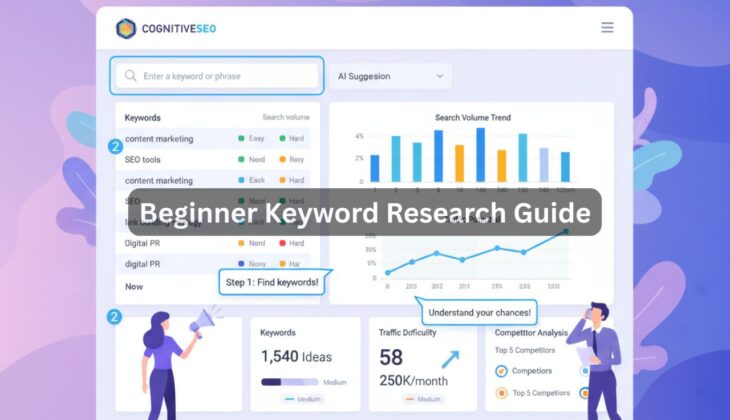
Effective keyword research follows a structured process that takes you from broad concepts to specific, actionable targets. CognitiveSEO’s toolkit simplifies this journey with features designed to uncover opportunities at each stage. Let’s break down the five essential steps that will transform your approach to finding and prioritizing keywords.
1. Generate Seed Keyword Ideas That Actually Matter
Every keyword research journey begins with seed keywords – the foundational terms most relevant to your business, products, or content. These aren’t necessarily the keywords you’ll end up targeting but serve as starting points to discover related opportunities. The quality of your seed keywords directly impacts the relevance of all subsequent research.
2. Expand Your List Using the Keyword Explorer Tool
Once you have your seed keywords, it’s time to unleash CognitiveSEO’s Keyword Explorer to discover related terms you might have missed. This powerful feature goes beyond basic suggestions to uncover valuable opportunities hidden from most competitors. Simply enter your seed keywords and watch as the tool generates a comprehensive list of relevant terms, complete with vital metrics.
The true power of Keyword Explorer lies in its filtering capabilities. You can quickly narrow down thousands of potential keywords based on search volume ranges, word count, difficulty, and relevancy score. This means less time sifting through irrelevant suggestions and more time analyzing viable opportunities. For beginners, the “relevancy score” is particularly valuable as it indicates how closely related each suggestion is to your original seed keyword.
3. Analyze Competitor Rankings to Find Gaps
Smart keyword research isn’t just about finding what to target—it’s also about identifying what your competitors have missed. CognitiveSEO allows you to analyze top-ranking sites in your niche to reverse-engineer their keyword strategy. This competitive intelligence reveals both which keywords are driving traffic to competitor sites and, more importantly, which valuable opportunities they’ve overlooked.
4. Filter Keywords by Difficulty, Volume and Opportunity
Not all keywords are created equal, and beginners need to be particularly strategic about which battles to fight. CognitiveSEO’s filtering system lets you quickly identify keywords with the ideal balance of search volume, competition level, and relevance. Start by focusing on keywords with difficulty scores below 30-40 (on the 100-point scale) to find opportunities where you can realistically compete while building your site’s authority.
5. Group Keywords by Topic for Strategic Content Planning
The final step in effective keyword research is organizing your findings into thematic clusters that can guide content creation. Rather than creating individual pages for each related keyword variation, group similar terms around a central topic. This approach aligns with how search engines understand topical relevance and creates a more cohesive user experience. CognitiveSEO helps identify these natural groupings through its relevancy scoring, making it easier to plan comprehensive content that captures multiple related terms.
CognitiveSEO’s Keyword Research Toolkit Explained
Understanding the full capabilities of CognitiveSEO’s suite of tools can transform your keyword research from a guessing game into a strategic advantage. The platform integrates three core features that work together to provide comprehensive keyword intelligence: Keyword Explorer, Ranking Analysis, and Content Assistant. Each tackles a different aspect of the research-to-content pipeline, creating a seamless workflow that takes you from initial research to optimized content.
Keyword Explorer: Finding Hidden Opportunities
The Keyword Explorer is the heart of CognitiveSEO’s research capabilities, designed to uncover thousands of keyword opportunities from a single seed term. Unlike many keyword tools that simply regurgitate Google’s suggestions, Keyword Explorer uses advanced algorithms to identify semantically related terms that might not be obvious connections. The interface presents key metrics in an intuitive format, making it easy for beginners to assess opportunities at a glance.
What sets this tool apart is its approach to displaying search volume. Rather than showing potentially misleading single figures, CognitiveSEO uses volume ranges that acknowledge the inherent variability in search data. The tool also provides a unique relevancy score that helps you quickly identify how closely related each suggestion is to your original query – an invaluable shortcut for assessing search intent alignment without having to analyze each term manually. For those interested in enhancing their analytics strategy, exploring real-time analytics can provide additional insights into boosting ROI.
Ranking Analysis: Reverse-Engineering Top Results
Once you’ve identified potential keywords, the Ranking Analysis feature helps you understand what it will take to rank for them. This tool examines the current top-ranking pages for your target keywords, showing exactly what content elements have helped them succeed. You’ll see which focus keywords they’re using, content length, readability scores, and other critical factors that influence rankings – essentially providing a blueprint for creating competitive content. To further enhance your strategy, consider exploring YouTube SEO and video promotion strategies as part of your content plan.
Content Assistant: Turning Keywords Into Optimized Content
Identifying keywords is only half the battle – you also need to implement them effectively in your content. The Content Assistant bridges this gap by analyzing top-ranking pages and identifying exactly which terms and topics you need to include to compete effectively. This data-driven approach takes the guesswork out of content optimization, ensuring you create comprehensive resources that satisfy both search engines and users.
How to Evaluate Keywords Like a Pro
The difference between amateur and professional keyword research lies in how you evaluate potential targets. Anyone can generate a list of keywords, but knowing which ones represent genuine opportunities requires a deeper analysis. CognitiveSEO provides several metrics that help you make these crucial assessments.
Effective evaluation considers multiple factors simultaneously rather than fixating on any single metric. The goal is to identify keywords that represent the sweet spot between opportunity (enough search volume to be worthwhile), competitiveness (realistic chance of ranking), and relevance (alignment with your business goals). The following metrics help you find this balance.
Difficulty Scores: What the Numbers Really Mean
Difficulty scores quantify how challenging it will be to rank for a particular keyword based on the authority and optimization of currently ranking pages. CognitiveSEO uses a 0-100 scale where lower numbers represent easier ranking opportunities. For beginners, focusing on keywords with difficulty scores below 30-40 provides the most realistic path to gaining visibility while building domain authority.
Search Volume: When Higher Isn’t Always Better
While high search volume might seem desirable, these keywords typically face fierce competition. CognitiveSEO’s approach to displaying volume as ranges rather than absolute figures helps you make more realistic assessments about traffic potential. For beginners, moderate-volume keywords (100-1,000 monthly searches) often provide better opportunities than high-volume terms, offering a balanced approach between visibility and competition.
The “Focus Keywords” Feature for Quick Wins
One of CognitiveSEO’s most valuable features for beginners is the Focus Keywords analysis, which identifies the terms that are most influential in helping top-ranking pages succeed. These aren’t always the primary keywords but often include important related terms that signal relevance to search engines. By incorporating these focus keywords into your content, you can quickly boost your topical relevance signals.
The real power of the Focus Keywords feature comes from showing you exactly which terms competitors are using that you might be missing. This intelligence helps you close content gaps and create more comprehensive resources that stand a better chance of ranking, even against more established competitors.
Questions Tab: Capturing Featured Snippet Opportunities
Featured snippets represent prime search engine real estate, appearing above traditional organic results. CognitiveSEO’s Questions tab identifies question-based queries related to your keywords that frequently trigger these featured snippets. By creating content that directly answers these questions in a concise, structured format, beginners can sometimes leapfrog more established competitors and capture these valuable positions. For those looking to enhance their strategy, exploring tools like TubeBuddy’s growth tools can provide additional insights into optimizing content for search engines.
Common Keyword Research Mistakes to Avoid
Even with the right tools, keyword research can go wrong if you fall into common traps. After working with hundreds of beginners, I’ve noticed certain patterns that consistently derail otherwise promising SEO strategies. Understanding these pitfalls can save you months of wasted effort and prevent the frustration of creating content that never ranks.
Most beginner mistakes stem from approaching keyword research as a technical exercise rather than a strategic marketing activity. Remember that behind every search query is a real person with specific needs and intentions. Your goal isn’t just to find terms with favorable metrics but to identify the intersection between what your audience seeks and what your business can meaningfully provide. For insights into how real-time analytics can enhance your strategy, consider exploring real-time analytics to boost your ROI.
The following mistakes represent the most common reasons why keyword strategies fail, even when using powerful tools like CognitiveSEO. By consciously avoiding these traps, you’ll immediately elevate your keyword research above most competitors in your space.
Ignoring User Intent Behind Keywords
The single biggest mistake beginners make is focusing exclusively on keyword metrics while ignoring the actual intent behind searches. A keyword might have perfect search volume and difficulty scores, but if your content doesn’t satisfy what users are actually looking for, you won’t rank well or convert visitors. Before targeting any keyword, examine the current top-ranking pages to understand what type of content Google considers relevant – informational guides, product comparisons, purchasing options, or something else entirely. For more insights, check out this Keyword Tool Documentation by CognitiveSEO.
Chasing Impossible Keywords
Ambition is valuable, but targeting ultra-competitive keywords too early wastes resources and kills momentum. New websites simply cannot rank for high-difficulty terms (70+ on CognitiveSEO’s scale) without extraordinary backlink profiles and domain authority. Instead, focus on winnable battles – keywords with lower difficulty scores where you can realistically compete while building your site’s overall authority.
Forgetting to Track Performance
Keyword research isn’t a one-and-done activity – it’s an ongoing process that requires monitoring and refinement. Many beginners fail to track which keywords actually drive traffic and conversions once content is published. CognitiveSEO’s tracking features allow you to measure performance over time, helping you double down on what works and pivot away from underperforming strategies.
The most successful SEO strategies evolve based on actual performance data rather than theoretical research. Set up regular reviews of your keyword performance (at least quarterly) to identify emerging opportunities and adjust your strategy based on real-world results rather than just initial research projections. For more insights, check out this keyword tool documentation.
Overlooking Location-Based Variations
Search behavior varies dramatically across geographic regions, with different terminology, competition levels, and search volumes. Many beginners make the mistake of targeting generic keywords without considering location-specific variations that might offer easier ranking opportunities or better alignment with their business service areas. CognitiveSEO allows you to research keywords with location modifiers, uncovering valuable regional opportunities that broader research might miss.
Turn Keywords Into Traffic: Next Steps After Research
Identifying the right keywords is just the beginning – the real value comes from implementing them effectively in your content strategy. With your CognitiveSEO research complete, it’s time to transform those insights into content that ranks and converts. Start by organizing your keywords into topic clusters, grouping related terms that can be targeted through comprehensive content pieces rather than creating separate pages for similar variations.
For each primary keyword, use CognitiveSEO’s Content Assistant to develop optimized content briefs that include all the related terms, questions, and topics necessary to create truly comprehensive resources. This data-driven approach ensures your content matches search intent while covering the subject thoroughly enough to compete with established pages. Remember that quality always trumps keyword density – focus on creating genuinely valuable content that naturally incorporates your target terms in context.
FAQ: Keyword Research for Beginners
Throughout my years helping beginners implement keyword strategies with CognitiveSEO, certain questions come up consistently. These represent the most common points of confusion for those new to keyword research, and understanding these fundamentals can significantly accelerate your SEO success.
The answers below reflect both best practices and the specific capabilities of CognitiveSEO’s toolkit. While other approaches exist, these recommendations provide the most direct path to results for those just starting their keyword research journey.
- What’s the difference between keyword research and topic research?
- How many keywords should I research before creating content?
- Should I target keywords with no search volume?
- Can keyword research help with existing content?
- How do I know if my keyword research is working?
While these questions represent common starting points, remember that keyword research is both an art and science. As you gain experience with CognitiveSEO’s tools, you’ll develop intuition about which opportunities best fit your specific situation and goals.
How many keywords should I target on a single page?
Rather than focusing on a specific number, think in terms of primary and secondary keywords. Each page should target one primary keyword (the main focus) and 3-5 closely related secondary keywords that share the same search intent. CognitiveSEO’s Content Assistant will automatically identify these related terms based on what’s working in top-ranking pages.
This clustered approach creates more natural, comprehensive content than trying to artificially incorporate dozens of loosely related keywords. The goal isn’t to hit a specific keyword density but to thoroughly cover the topic in a way that naturally includes relevant terminology while satisfying user intent.
Remember that modern search engines understand semantic relationships between terms. You don’t need to repeat exact keyword phrases verbatim throughout your content – using natural variations and related concepts signals topical relevance more effectively than keyword stuffing ever could.
Is keyword density still important for SEO?
The concept of keyword density (the percentage of times a keyword appears relative to total word count) is largely outdated in modern SEO. Today’s search algorithms use far more sophisticated methods to determine relevance, including semantic analysis, user behavior signals, and content comprehensiveness. Rather than focusing on arbitrary density percentages, use CognitiveSEO’s Content Assistant to identify the topics, terms and questions that should be included to create truly comprehensive content.
How often should I update my keyword research?
“Search is a living entity that continually evolves. Your keyword strategy should evolve with it.”
Keyword research should be reviewed quarterly at minimum, with more frequent updates in rapidly changing industries. Search behavior shifts as trends evolve, new products emerge, and terminology changes. CognitiveSEO’s tracking features make these regular reviews straightforward, allowing you to identify emerging opportunities and terms losing relevance.
Pay particular attention to seasonal variations in your niche. Many industries experience predictable fluctuations in search patterns throughout the year. By identifying these patterns through regular research updates, you can develop content calendars that align with predictable search trends.
Additionally, any major business changes – new products, services, or market expansions – should trigger a fresh round of keyword research focused on these new opportunities. This ensures your SEO strategy remains aligned with current business priorities rather than becoming detached from your core objectives.
Finally, algorithm updates can sometimes shift how search engines interpret specific queries. After significant Google updates, review your keyword performance to identify any terms where rankings have unexpectedly changed, as this may signal evolving interpretations of user intent.
Can I rank for keywords if my website is brand new?
- Yes, but be strategic about which keywords you target initially
- Focus on lower-difficulty, longer-tail keywords with clear intent
- Prioritize creating exceptional content that thoroughly answers user questions
- Build authority gradually by earning backlinks to your best content
New websites can absolutely rank for carefully selected keywords. The key is being realistic about which terms you can compete for during your site’s early stages. CognitiveSEO’s difficulty scores are particularly valuable for new sites, as they help identify opportunities where even sites with limited authority can potentially rank.
When starting from scratch, focus on highly specific long-tail keywords (difficulty scores under 30) that have clear user intent. These terms typically have lower competition while still driving valuable, conversion-ready traffic. As you build authority through quality content and earn backlinks, you can gradually expand to more competitive terms. For instance, understanding YouTube SEO strategies can enhance your video content’s reach and effectiveness.
Remember that content quality matters even more for new sites. Without established domain authority, your content needs to be exceptionally thorough and valuable to earn rankings. Use CognitiveSEO’s Content Assistant to ensure your pages cover topics more comprehensively than competitors, giving search engines a reason to rank your content despite your site’s newness.
Does CognitiveSEO work for local keyword research?
Yes, CognitiveSEO is particularly effective for local keyword research when you use location modifiers with your seed keywords. For example, rather than searching just for “dentist,” try “dentist in [city]” to uncover location-specific opportunities. The platform’s filtering capabilities allow you to identify local terms with reasonable competition levels, helping businesses target geographic-specific searches.
For multi-location businesses, create separate keyword research projects for each service area to identify location-specific variations in terminology and competition. You’ll often find that the same service has dramatically different keyword difficulty scores across different locations, revealing opportunities that might be missed with generic research.
CognitiveSEO’s competitor analysis features are especially valuable for local businesses, as they allow you to see exactly which keywords are driving traffic to successful local competitors. This competitive intelligence helps you identify high-converting local terms you might otherwise overlook in general research.
To maximize the value of CognitiveSEO for local research, combine it with Google Business Profile insights to align your keyword strategy with how customers actually discover and interact with local businesses in your industry. This integrated approach ensures your content targets the specific terms potential customers use when looking for local solutions.